In Moonlight Peaks, Ihre Maschinen haben Persönlichkeit. Der Refiner ist ein rosafarbener kleiner Gremlin mit großem Maul, der ganze Baumstämme frisst und Bretter ausspuckt; Das Keg trägt winzige Fledermausflügel an seinen Reifen. Das sind Ihre Helfer auf dem Bauernhof – die platzierbaren Maschinen, die Rohfrüchte, Holz, Steine und Erz in alles verwandeln, was es wert ist, besessen zu werden – und diese Seite sammelt alle, die wir gesehen haben, mit dem bestätigte Herstellungsrezepte aus der Demo und die längere dataminierte Liste dessen, was zum Start kommt.
Kurzversion: Sie schalten Farm Helpers frei als Blaupausen, fertige sie aus dem Build-Menü, platziere sie irgendwo auf deinem Grundstück und füttere sie. In der Verarbeitung steckt das Geld – sehen Sie sich unsere an Geldratgeber warum Rohware fast immer das falsche Verkaufsargument ist.
Kernmaschinen und Baurezepte
Diese Rezepte wurden zuerst in der Demo erfasst und sind in den Tabellen der Startversion der Community verblieben. Wir behalten diese Herkunft bei, anstatt einen nicht zitierten Screenshot als neue offizielle Bestätigung zu präsentieren.
| Maschine | Was es tut | Rezept | Größe |
|---|---|---|---|
| Refiner | Veredelt Rohstoffe – Holz zu Brettern, Stein zu raffiniertem Stein | 20 Holz, 20 Stein | 4×3 |
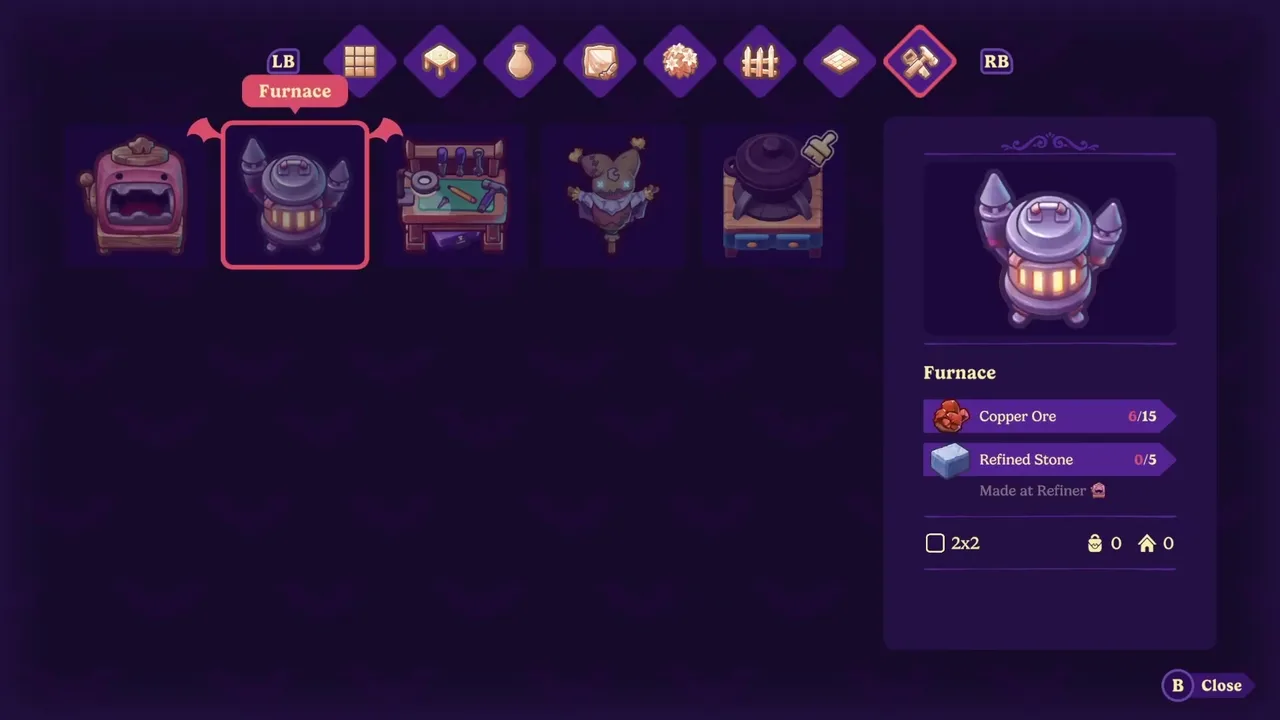
| Ofen | Schmilzt Erz zu Metallbarren (Kupfer, Eisen) und Kohle | 15 Kupfererz, 5 raffinierter Stein | 2×2 |
| Workbench | Allgemeine Handwerksstation | 30 Holz | 4×2 |
| Kochstation | Kochen im Freien – siehe Kochen & Rezepte | 5 raffinierter Stein, 5 Bretter | 2×2 |
| Fass | Verwandelt Produkte in Saft, Bier und Wein | 20 Holz (Werkbank) | klein |
| Kräutergarten | Eigenes Grundstück – das Nur only Kräuter wachsen lassen | Früher Bauplan (ein Geschenk deiner Mutter) | groß |
| Vogelscheuche | Erscheint im Build-Menü neben den Maschinen | Noch nicht erfasst | — |
A Webstuhl – zum Weben ätherischer Fäden in Stoff – taucht auch in der Demo-Mail als baubares Objekt auf, also erwarten Sie es auch zu Beginn der Vollversion des Spiels.
Die oben genannten Baukosten hielten sich beim Start. Baupläne für den Ofen, das Fass und den Refiner stammen von Workbench; die Mühle wird von der gekauft Heulender Hammer Tischlerei statt.
Was jede Maschine herstellt (bestätigte Rezepte)
Jetzt, da das Spiel draußen ist, können wir die genauen Ausgaben für die drei Kernprozessoren auflisten – die Maschinen, in denen Sie leben werden. Die Muster sind klar: Saft benötigt 3 Früchte, Wein benötigt 4 Trauben und jeder Metallbarren benötigt 1 Holzkohle.
Fass – Getränke. Füttern Sie es mit Obst, Weizen oder Weintrauben:
| Ausgabe | Rezept |
|---|---|
| Alle Früchte Saft (Brombeere, Blaubeere, Cranberry, Zitrone, Melone, Himbeere, Erdbeere, Bluttraube, Blutorange, Weiße Traube) | 3 dieser Frucht |
| Bier | 3 Wily Wheat |
| Rotwein | 4 Bluttrauben |
| Weißwein | 4 weiße Trauben |
Ofen – Schmelzen. Beachten Sie, dass jeder Riegel auch Holzkohle frisst, die der Ofen aus einfachem Holz herstellt:
| Ausgabe | Rezept |
|---|---|
| Holzkohle | 1 Holz |
| Kupferbarren | 4 Kupfererz + 1 Holzkohle |
| Eisenbarren | 4 Eisenerz + 1 Holzkohle |
| Goldbarren | 4 Golderz + 1 Holzkohle |
Refiner – Rohstoffe und Tierfutter:
| Ausgabe | Rezept | Erträge |
|---|---|---|
| Planken | 3 Holz | 1 |
| Weiche Planken | 3 Helles Holz | 1 |
| Hartholzbretter | 1 Herzstein | 1 |
| Veredelter Stein | 6 Stein | 1 |
| Stein | 1 Herzstein | 20 |
| Futter | 1 Faser | 2 |
| Deluxe-Futter | 50 Futter + 1 Manaessenz | — |
Zwei Dinge, die es wert sind, erwähnt zu werden: Der Refiner knackt einen Single Herzstein in 20 Stein, ein glücklicher Mining-Drop speist also eine Menge Gebäude; und Deluxe-Futter bindet Ihre Zauberwirkung Wirtschaftlichkeit zu Ihrem Vieh, da es Mana-Essenz benötigt.
Die Verarbeitungskette (warum der Refiner an erster Stelle steht)
Farmhelfer füttern sich gegenseitig, und die Reihenfolge zählt:
- Refiner zuerst. Holz und Stein sind überall; der Veredler verwandelt sie in Bretter und veredelter Stein – und fast alles andere ist gebaut von diese. Sogar der Ofen braucht raffinierten Stein.
- Ofensekunde. Kupfererz wird aus den Felsen rund um Ihr Grundstück gewonnen Kupferbarren (später Eisenstangen) – die Zutat hinter Lampen, Schubkarren und stabilerer Ausrüstung.
- Dann die lustigen. Fässer, die Kochstation und der Kräutergarten verwandeln Ihr Kulturen in Dinge, für die die Leute tatsächlich bezahlen.
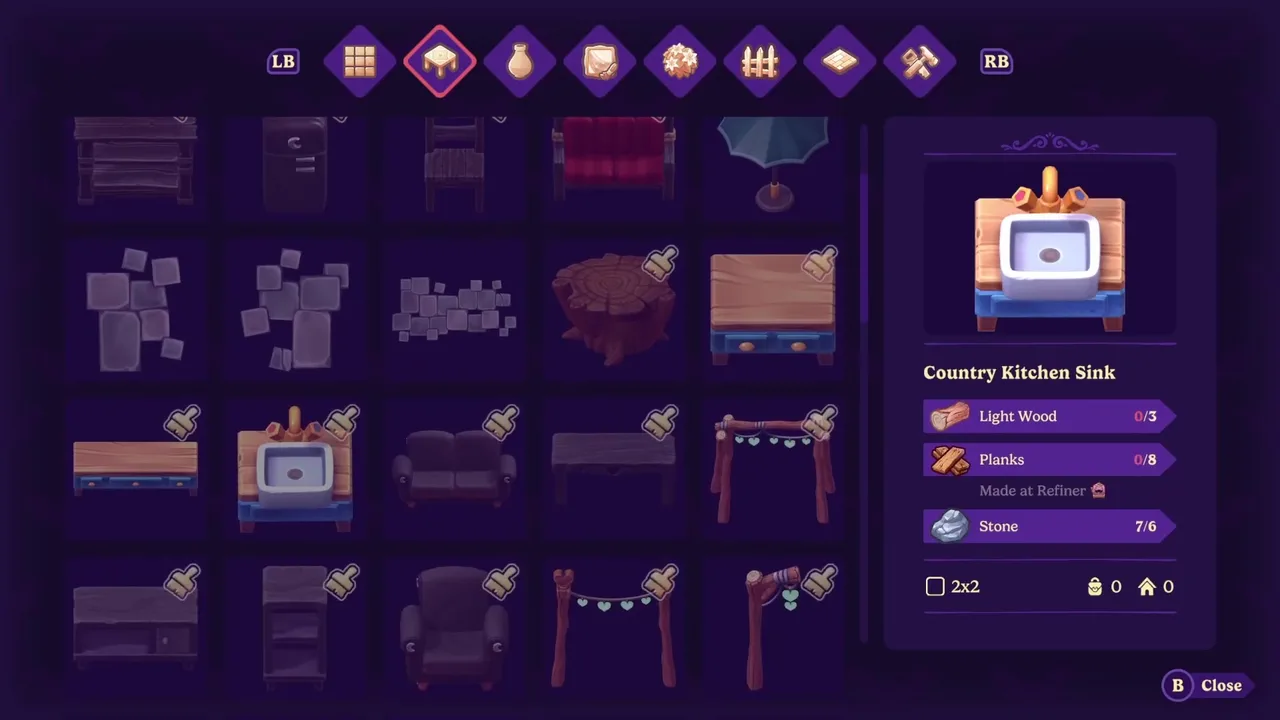
Sie sehen die Kette direkt in der Handwerksoberfläche: Möbelrezepte sind getaggt „Hergestellt bei Refiner“ oder „Hergestellt im Ofen“, sodass das Spiel Ihnen genau sagt, welche Maschine welchen Gegenstand sperrt. Auch die Dekoration Ihres Hauses läuft über diese Maschinen – die Hälfte des Katalogs in unserem Dekorationsanleitung beginnt sein Leben als Baumstamm im Mund des Veredlers.
Fässer: die Weinwirtschaft
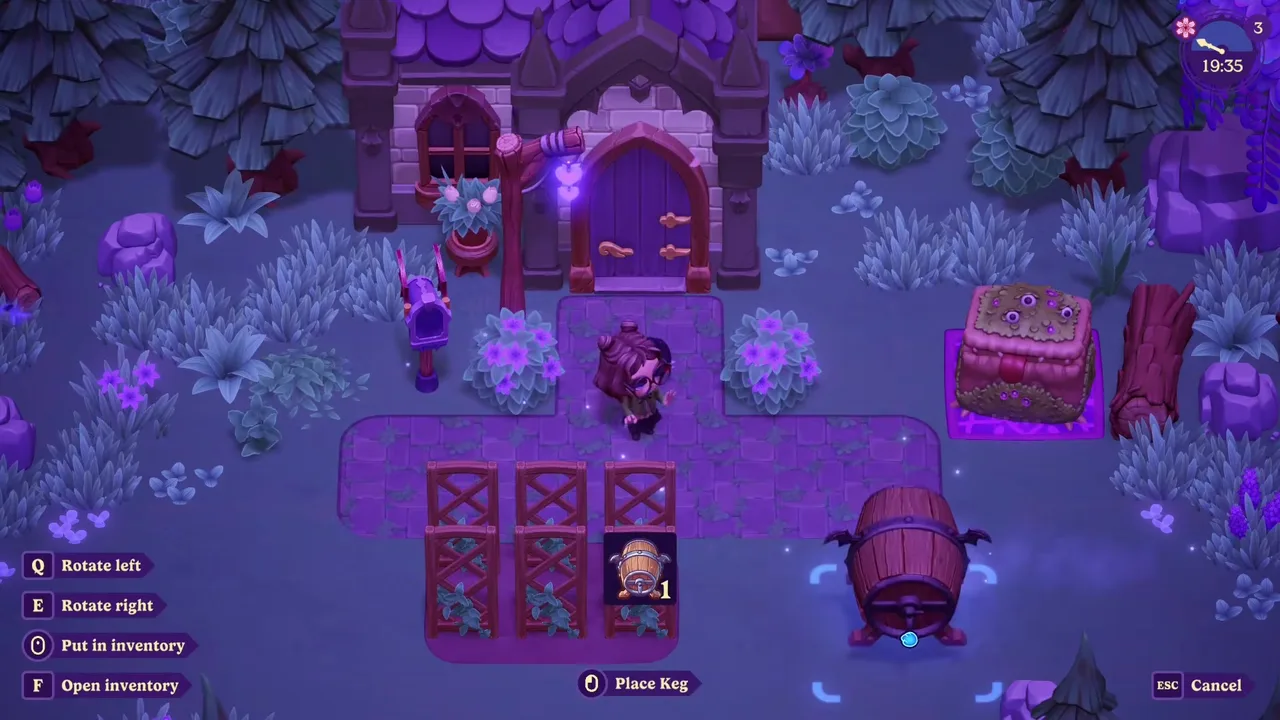
Das Fass verdient einen eigenen Absatz, weil die Stadt praktisch davon lebt. Orlocks erste Quest ist im wahrsten Sinne des Wortes eine Weinbestellung, und Demo-Spieler sind sich einig: „Sie werden viele Fässer brauchen.“ Produkte gehen ein; Saft, Bier und Wein herauskommen, weit mehr wert als die Rohernte. Fässer sind kompakt und können überall platziert werden – ein Spieler stellt sie direkt neben das Bett, was entweder Effizienz oder ein Lifestyle-Statement ist.
Trauben → Fass → Rotwein ist noch eine frühe Geldschleife, aber die Einführungstabellen bieten uns jetzt einige konkrete Alternativen. Hierbei handelt es sich um von der Community gemeldete Ausgabewerte. Durch Schrägstriche getrennte Zahlen werden exakt wiedergegeben, da wiki.gg die Ebenen nicht beschriftet hat.
| Fass-Ausgabe | Eingabe | Energie | Gemeldeter Verkaufswert |
|---|---|---|---|
| Bier | 3 Wily Wheat | 1 / 2 | 420 / 520 |
| Bluttraubensaft | 3 Bluttrauben | 40 / 50 | 100 / 120 |
| Weißer Traubensaft | 3 weiße Trauben | 3 / 5 | 120 / 180 |
| Melonensaft | 3 Melone | 3 / 4 | 300 / 380 |
| Mondsaft | 3 Mondfrucht | 50 | 320 |
Das macht das Keg zu mehr als einer reinen Weinmaschine: Bluttraubensaft und Mondsaft sind glaubwürdige Notnahrungsmittel, während Sie noch eine volle Speisekammer aufbauen. Bewahren Sie genügend Trauben für Orlock und Rezepte auf, bevor Sie jede einzelne in die Maschine geben.
Kräutergarten: Kräuter spielen nach anderen Regeln
Kräuter kann nicht auf normalem Ackerland gepflanzt werden. Sie brauchen den eigenen Kräutergarten – ein großes Grundstück, das Sie als Blaupause Ihrer Mutter schon früh erhalten – und in den sie sich direkt einpflanzen Trankbrauen. Dataminierte Maschinen deuten darauf hin, dass die Kräuterpipeline tiefer geht: a Kräuter-Trockengestell um sie zu trocknen und a Mörtel um getrocknete Kräuter zu Gewürzen zu mahlen Kochen.
Die vollständige Liste mit 16 Maschinen
Das Startspiel bestätigt 16 Farmhelfer insgesamt. Abgesehen von den drei oben genannten Kernprozessoren sind diese alle im Spiel – ihre Jobs sind bestätigt, aber ihre genauen Input→Output-Rezepttabellen werden noch von Spielern katalogisiert:
| Maschine | Was in den Dateien steht |
|---|---|
| Kräuter-Trockengestell | Kräuter und Pflanzen zum Trocknen aufhängen |
| Mörtel | Mahlt getrocknete Kräuter und Lebensmittel zu Gewürzen |
| Bienenhaus | Fährt Bienen; Sammeln Sie in regelmäßigen Abständen Honig |
| Webstuhl | Webt Materialien aus ätherischen Fäden |
| Käsepresse | Käse aus Milch – passt zu Ihrem Draculambs & Vieh |
| Manaextraktor | Extrahiert Essenz aus magischen Pflanzen – Treibstoff für Ihre Zauberwirkung |
| Mühle | Mahlt Ressourcen zu Pulvern (denken Sie an Mehl) |
| Jam Maker | Töpfe mit Marmelade aus Früchten |
| Firefly Sanctuary | Pflegt Glühwürmchen; produziert Feuertropfen |
| Glühwürmchen-Bestäuber | Steigert die Pflanzenqualität in einem 9×9-Raster darum herum |
| Chocolatier | Pralinen |
| Seed-Sequenzer | Produziert Samen – wahrscheinlich aus Feldfrüchten im Stardew-Samenmacher-Stil |
Das Herausragende: das Glühwürmchen-Bestäuber ist der erste bestätigte Eintrag Qualität Mechanik, die wir für Feldfrüchte gesehen haben – eine 9×9-Aura ist enorm und Farmlayouts werden um sie herum gebaut. Und die Manaextraktor antwortet endlich, wie eine Farm ein Zauberbuch ernährt.
Die Platzierung ist nachsichtig
Nichts, was wir gesehen haben, deutet darauf hin, dass Sie Ihr Layout blockieren können. In der Demo Sie Maschinen frei drehen (Q/E auf dem PC), sie wieder aufnehmen und wieder platzieren nach Belieben – platzieren Sie Ihren Refiner also an einem beliebigen Ort und planen Sie später neu, wenn der Firefly Pollinator 9×9-Gitter zum Gesetz des Landes macht. Weitere Handlungsplanung im Tipps für Anfänger.
Noch zu bestätigen
Verarbeitung mal, Ausgabe Werte, Maschine Upgrade-Stufenund ob die Vogelscheuche tatsächlich etwas abwehrt – davon ist noch nichts geklärt. Wir geben die genauen Zahlen ein, sobald die Daten der Startversion stabil sind, und kennzeichnen bis dahin alles, was aus Demoquellen stammt.
Neu im Spiel? Beginnen Sie mit alles was wir wissen, dann die Komplettlösung für die erste Woche – Ihr Refiner ist am zweiten Tag hungrig.